Thursday, 8 October 2015

Comparison between Skyfall and Kingsman


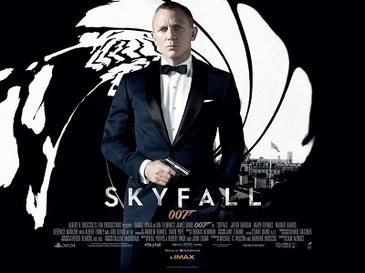
In this analysis, I am going to be comparing the two films: Kingsman and Skyfall, focusing particularly on genre, narrative and representation. Kingsman was directed by Matthew Vaughn and he also wrote the screenplay along with Jane Goldman which was based upon a comic book by Mark Millar and Dave Gibbons. It was produced in 2014 by Matthew Vaughn, Adam Bohling and David Reid with 20th Century Fox (also the distributer). Skyfall, on the other hand, was directed by Sam Mendes and written by Neal Purvis, Robert Wade and John Logan. It was produced in 2012 by Barbara Broccoli and Michael G. Wilson with Eon Productions, with the distributer being MGM. Both films were of a high budget: Kingsman was $81 million and Skyfall was much higher at $200 million. Regarding their box offices, Skyfall became the highest grossing film in the UK as well as the highest grossing film worldwide for MGM and Sony Pictures after it made an incredible $1, 108 million. Kingsman also did very well, grossing an overall total of $412.1 million which made it Matthew Vaughn’s most commercially successful film. I believe Skyfall did better in the box office than Kingsman because the James Bond films have been a running series since 1962 (Dr. No) so it has developed a wide audience base since then who will keep coming back to watch the newest Bond movie as they know what to expect. Also Kingsman was released at the same time as Fifty Shades of Grey which may have stolen some of its limelight due to its strong controversy.

Both films have a different cast with Kingsman starring: Colin Firth (Harry), Taron Egerton (Eggsy), Samuel L. Jackson (Valentine) and Sofia Boutella (Gazelle) and Skyfall starring: Daniel Craig (James Bond), Judi Dench (M), Javier Bardem (Silva) and Ralph Fiennes (Gareth). They share the genres of action, adventure and crime because they both follow a spy-agency, resulting in the usual conventions such as missions, murders, ‘saving the world’ and of course, both protagonists have a goal. The goal of Eggsy is to become a Kingsman by competing in a series of tests against the other recruits and to help prevent the antagonist, Valentine from destroying the world with his newly invented sim card. Similar to Eggsy, Bond’s goal is to defeat the antagonist, Silva and therefore save his agency, M16. As the Bond films have been running since 1962, the audiences are likely to have expectations regarding the elements that make up Skyfall, therefore suggesting that the series has established its own genre. For example, the opening scene of Skyfall and other Bond films jumps straight into intense action, clearly illustrating its genre and immediately sparking the audiences interest, meaning they are gripped within seconds. Kingsman also did exceptionally well with their opening and it transported the audience straight into the action genre, giving them an insight into what to expect for the remainder of the film and I feel a strong opening scene is particularly important for these genres because the audience have expectations for a fast paced, action-packed experience so want their interest to be gained immediately.


Within these genres, there are additionally expected plot situations such as chase and fight sequences which are seen in both of these films, however executed in slightly different ways. Skyfall takes a more traditional approach with explosions, fast paced editing and rapid cuts which makes the audience feel as if they are a part of the action and although Kingsman also includes these elements, it has the added genre of comedy which provides a sense of humour to some of the fight scenes. An example of this is the church scene because although the characters have been turned ‘evil’ by Valentine, there is upbeat music playing in the background which would usually be used to create a positive atmosphere so therefore it is being juxtaposed with the violence in the scene. Audio codes are key in action films and Bond movies are known for their recognisable sound tracks and unique theme tunes and of course, Skyfall has incorporated this into their ‘plot situations’. For example, the fight scene between James Bond and Patrice that takes place at Shanghai incorporates a build-up of dramatic, non-diegetic music that creates tension and the low key lighting results in Bond and Patrice being silhouettes against the city lights, showing their fight in a sophisticated manner and for both Skyfall and Kingsman, the action sequences are ‘stylised and professional’.

Both Skyfall and Kingsman follow a linear narrative structure but with multiple strands within it, which is known as a flexi-narrative. In Skyfall, the narrative strands include Bonds goal to defeat Silva, Bonds struggle to cope with his ageing and vulnerability and the threats towards M and the pressure this is causing her and all of these intertwine with the as so mentioned plot situations to create a more challenging narrative. The different strands in Kingsman are: Eggsy training to become a gentleman spy, the problems caused by the invention of Valentines new sim card and family issues regarding Eggsy’s mum and step-dad. These all combine together to increase the complexity of the narrative which furthermore challenges the audience and keeps them watching.

Todorov’s theory fits in with the narrative of Kingsman and Skyfall but again, it is more complex and there is more than one disruption/realisation in each. I am going to break each of them down in a list format.

Skyfall
Equilibrium: Action sequence at the beginning of the film because it is expected of this genre.
Disruption: The ‘death’ of Bond.
Disruption 2: When Silva hacks M16’s system and steals the details of all the undercover agents.
Realisation: Bond returns to active service to eliminate Silva.
Realisation 2: Final action sequence that takes place at Skyfall, it is the big climax to the whole narrative.
New Equilibrium: The end scene leaves the audience with enigma codes regarding Bonds new mission, he is back to active service again.


Kingsman
Equilibrium: Eggsy lives at home with his mother and step-father. Stealing the car (this is his normal lifestyle).
Disruption: Eggsy gets sent to prison but then gets freed by Harry.
Realisation: The pub scene, Eggsy realises what he is getting himself into.
Disruption 2: Valentines invention of the sim card in which he is set to destroy the world.
Disruption 3: Eggsy does not make it as a Kingsman.
Realisation 2: Eggsy discovers the gun he would have used to shoot his dog was a blank.
Disruption 4: Harry dies.
Realisation 3: Eggsy helps to save the world by eliminating Valentine.
New Equilibrium: All the antagonists have been destroyed and Eggsy celebrates with a girl he met.


The most immediate comparisons I have made between Kingsman and Skyfall revolve around representation and there is a huge variety of different portrayals but I am going to discuss masculinity, age and class. Masculinity and what it is to be seen by a society as a ‘true man’ is huge in both of these films as they are both a ‘test’ of the protagonist’s masculinity and it is believed that they have to fit into the stereotype of being: strong, heroic, brave, independent and popular with women. In Kingsman, Eggsy has to undergo a series of tests which examine him on most of these qualities, meaning in order to be a true Kingsman, he has to tick the boxes of masculinity. However saying this, the representation of the ideal man is definitely challenged in the film because Harry encourages Eggsy to be respectful, protective and fair towards women and near the beginning of the film, we also find out that Eggsy used to be a gymnast to which he was forced to quit by his step-father as he did not see the sport as ‘manly’, showing their juxtaposed opinions on masculinity and gender roles. Also, Eggsy’s masculinity is challenged when he could not shoot his dog to reach the next stage of becoming a Kingsman and this event was foreshadowed at the beginning of the film when he swerves and crashes a car to avoid hitting an animal on the road, showing him to have a strong heart. Similarly, Skyfall also challenges this subject matter because although at the start of the narrative, Bond survives what could have been an awful death, gambles, drinks and sleeps with women which are stereotypical ‘masculine’ traits, as the narrative progresses we as an audience can see a transformation in Bond who has become physically weaker, shown through his tests in which he is unable to shoot accurately and struggles with his stamina, highlighting his vulnerability. Throughout the film, Bond is trying to prove himself as a man and overcome the barriers that are preventing this but we are constantly seeing him struggle meaning the audience cannot help but emphasise with him.


Kingsman focuses on the representation of youth whereas Skyfall more so focuses on the representation of older age. At the beginning of Kingsman, youth is represented negatively because we see Eggsy and his friends steal a rival gang’s car and they get into a car chase with the police, resulting in Eggsy ending up in prison. This represents young people, specifically males, as being ruthless, careless, violent and as ‘troublemakers’ which is enhanced by the iconography at the beginning which includes an estate and ‘chav’ like clothing. However, as the narrative progresses and the audience see Eggsy slowly transform into a gentleman, our views on his youth change and he is now respected and looked upon in a positive manner. It is awful that in order for Eggsy to be seen as a good figure in society, he had to wear a suit and act like a ‘real man’ because it illustrates the harsh stereotypes forced upon youths. Skyfall represents older age in both a positive and negative manner. It is represented positively within the character of ‘M’ who is an older woman with a significant amount of power in the government and therefore has the ability to be in control. However, the negative impacts of ageing are strongly highlighted in Skyfall because M is at times portrayed as vulnerable due to her age and I believe that throughout the film, this is foreshadowing (spoiler alert) her death at the end. Bond’s older age is a big focus in the narrative and there are many close ups of him that express his exhaustion and vulnerability and this along with the fact he failed his tests and was told he can “stay dead” conveys he is no longer fit for the job, representing people of an older age as weak and almost ‘useless’.


Our dominant ideology (straight, white, middle-aged, middle-class males) plays a huge role in the representation of class and it also explains why our main protagonists in both Kingsman and Skyfall fit into most of these categories, because the producers are members of our dominant ideology and have designed characters that mirror themselves, making them more “relatable”. Skyfall only represents those of the middle/upper class, portraying them to be the superior beings and it suggests that in order to have a significant amount of power, you have to dress, act and be brought up in the same environment as the characters in this film. However, in Kingsman, Eggsy comes from a working class background and he proves that you do not have to be higher class in order to become a Kingsman and this is reinforced by Harry who tells him that being a gentleman spy is not about your class, accent, clothing choice etc. but in fact, is about being “comfortable in your own skin”. This provides a much more realistic representation for the audience who will now be able to relate to Eggy to a greater extent because negative classism is not being forced upon them like it is in Skyfall.


In conclusion, there are many similarities and differences between Kingsman and Skyfall regarding genre, narrative and representation and I feel there is a lot to discuss in each meaning they are both rich media texts. Due to its comedic side, I preferred Kingsman and I also found it more ‘refreshing’ compared to other spy films I have seen. Overall, they are both excellent films and I would rate Kingsman 9.5/10 and Skyfall 7/10. 

Sunday, 4 October 2015

News Article 17

50% OF TEACHERS IN ENGLAND WANT TO QUIT?

Stressed teacher

The National Union of Teachers have recently conducted a survey which showed that 53% of the teachers in England are planning on quitting their job in the next two years. It illustrates that 61% of those wanting to quit are blaming it on their workload and 57% are desiring a better work/life balance. 

This is how BBC News represented the story:


Two thirds of the 1,020 primary and secondary school teachers questioned felt morale in the profession had declined over the past five years. Schools minister Nick Gibb pledged to tackle excessive workloads.
The findings of the survey are timely, because last month the five main teaching unions warned of a crisis in recruitment and retention, although the government maintains the vacancy rate has stayed stable at about 1%. The survey, undertaken with a representative sample of teachers, also suggested many were unhappy with some of the government's plans.
  • 76% said forcing schools that require improvement to become academies would damage education
  • 62% said the plans for 500 new free schools would also damage education
  • 54% were not confident the new baseline test for four-year-olds would provide valid information about a child's ability
General secretary of the NUT, Christine Blower, said: "This survey demonstrates the combined, negative impact of the accountability agenda on teacher workload and morale. Teachers feel that the Department for Education's work thus far to tackle workload has been totally inadequate. Meanwhile, nearly one million more pupils are coming into the system over the next decade. The government's solution so far has been to build free schools, often where there are surplus places, and to allow class sizes to grow. Add to this a situation where teachers are leaving in droves and teacher recruitment remains low. We now have a perfect storm of crisis upon crisis in the schools system."
She added that many teachers felt their pay had been eroded over a long period of time, and that many were missing out on the 1% pay rise because of the tightness of school budgets.
Mr Gibb said teaching remained "a hugely popular profession with the highest numbers of people joining since 2008. The latest figures show the number of former teachers coming back to the classroom has continued to rise year after year - from 14,720 in 2011 to 17,350 in 2014.
"While the vast majority of teachers stay in their roles for more than five years, we know unnecessary workload can detract from what matters most - teaching. That's why we launched the Workload Challenge and are working with the profession to understand and tackle the top issues that teachers said caused the most bureaucracy, with leading education experts taking action on key areas such as marking and lesson planning."
My opinion on the news story:
When I first read this article, I was quite shocked as to how many teachers want to quit there job and I did not expect it to be over 50% of them. I personally feel 'the workload challenge' is a great idea because teachers are such a key part to the educational system and obviously improvements need to be made if so many of them want to leave for a better lifestyle. However saying this, jobs are not supposed to be easy and of course they are going to be challenging at times so I think their excuse to leave because over the workload is quite poor. 

Sunday, 27 September 2015

News Article 16

New James Bond theme song triggers contrasting opinions 

Listen to the song here: http://www.buzzfeed.com/richardhjames/listen-to-sam-smiths-bond-tune-writings-on-the-wall#.osEoD7PXp


The new James Bond film, Spectre features Sam Smith for its theme song: "Writing's On The Wall". It was released on the 25th September and since, there has been a variety of opinions on it, both positive and negative. This is how BBC news represented the story: 

Former Bond actor Sir Roger Moore called Writing's On the Wall "very haunting and wonderfully orchestrated". But other Twitter users have been less complimentary, with one describing it as the "worst Bond theme ever". BBC entertainment correspondent Colin Paterson said it was "good enough, but not a classic".
The song, whose full version runs for 4 minutes and 38 seconds, begins with the words: "I've been here before / But always hit the floor." "I've spent a lifetime running, and I always get away," it continues. "But with you I'm feeling something, that makes we want to stay."
"I think it's a song about a man deciding to quit it all for love," Paterson said of the track on BBC Breakfast, comparing its melody to that of Michael Jackson's 1995 single Earth Song. He also suggested it was far superior to Die Another Day, the much-derided song Madonna contributed to the 2002 Bond film of that name.
Comedian David Schneider was not convinced, greeting the song's release with the words: "The name is Bland. James Bland."
Yet fellow comic Omid Djalili was far more effusive, tweeting the song had left him "in a broken heap." "If you're not moved by this song you don't have a pulse," wrote Djalili, who had a small role in 1999 Bond film The World is Not Enough.
Here are some tweets in response to the song: 
@samsmithworld has delivered a very haunting and wonderfully orchestrated theme song. Well done!
Not sure on what to make out of - sounds more like Moulin Rouge rather than James bond
Sam Smith says he wrote the Bond song in 20 mins - it sounds like it...it's an ersatz insult to all the great falsetto voices...
Spectre is being released on the 26th October in the UK.

My opinion on the news story:

After listening to the new theme song, I am not a huge fan because it seems rushed and the actual song does not suit Sam Smiths vocal range in my opinion. I feel a lot more effort could have been put into it, especially after previous theme songs such as "Skyfall" and "You Know My Name" which really raised the bar. I believe that "Writing's On The Wall" failed to compete with these songs and therefore I do not see it being at the top of the charts in the upcoming weeks, especially as no Bond song has ever reached number one. 

Monday, 21 September 2015

Fruitvale Station Analysis


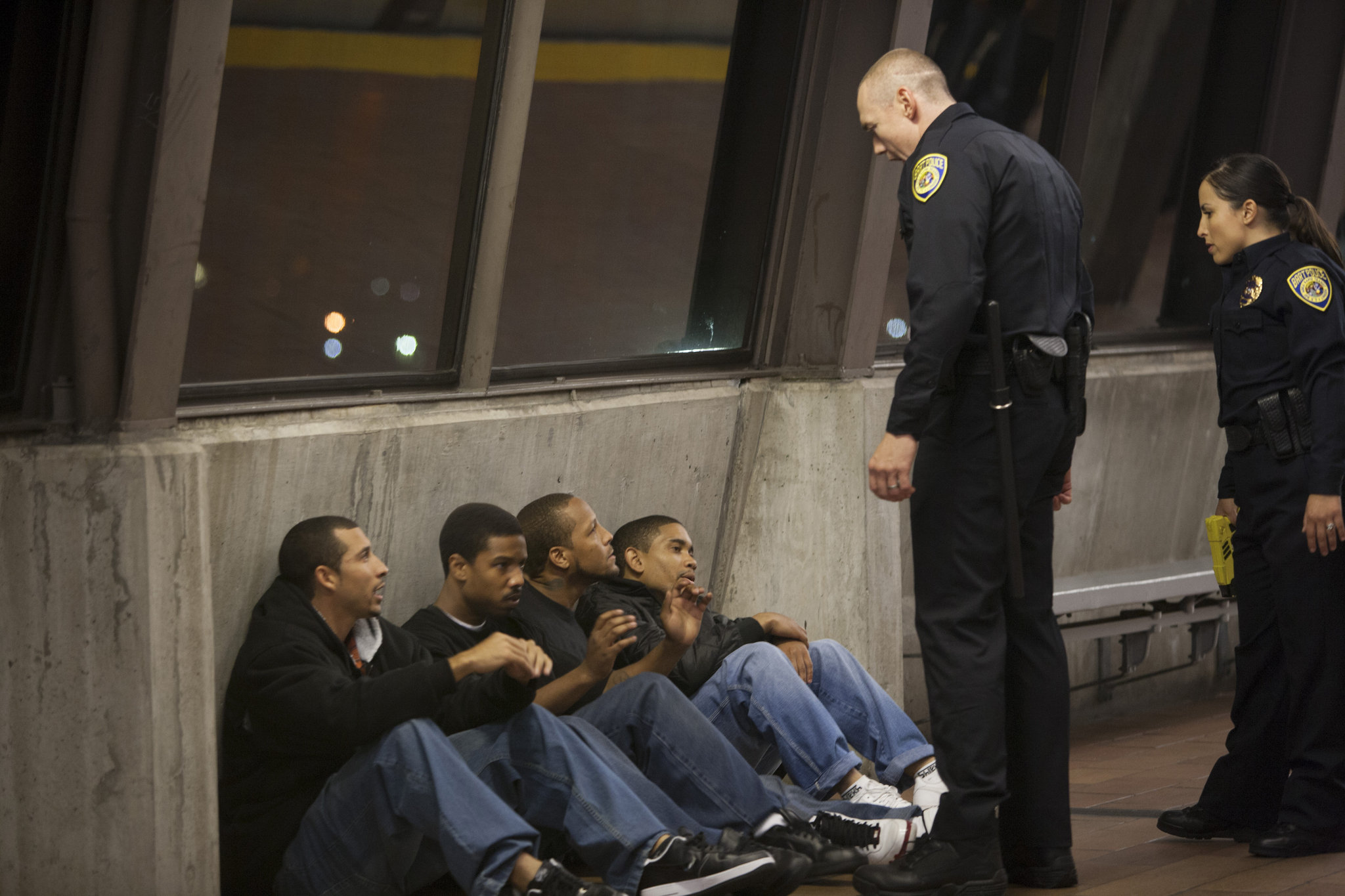
Fruitvale Station is a biography, drama, romance film that was directed and written by Ryan Coogler. It was produced in 2013 by Nina Yang Bongiovi and Forest Whitaker with Forest Whitaker’s Significant Productions and OG Project. It was distributed in the USA by The Weinstein Company. The music was by Ludwig Goransson, the DOP was Rachel Morrison and the editors were Claudia Castello and Michael P. Shawver. Fruitvale Station had a budget of $900,000 and went on to make $17.4 million in the box-office, with $16 million coming from the United States alone. This resulted in the film winning 49 awards including an AAFCA for the best independent feature film and an AFI for movie of the year. Starring Michael B. Jordan (Oscar Grant), Melonie Diaz (Sophina), Octavia Spencer (Wanda), Ariana Neal (Tatiana), Kevin Durand (Officer Caruso) and Chad Michael Murray (Officer Ingram), Fruitvale Station is based upon the true story of Oscar Grant III who was shot by a BART policeman at Fruitvale Station on January 1, 2009 at 2:15 am. The film follows Grant’s last day and we learn more about him through his encounters with friends, family, enemies and strangers and how he tries to make himself a better person.

Fruitvale Station was Ryan Coogler’s first feature film and when Oscar Grant was shot, Coogler was a graduate student at the University Of Southern California School Of Cinematic Arts. He then wanted to make a film about Grant’s last twenty four hours and in order to do this, he had to work closely with Grants family and their attorney, John Burris in order to gain realistic and heartfelt information. Coogler quotes: “I wanted the audience to get to know this guy, to get attached, so when the situation that happens to him happens, it’s not just like you read it in the paper”. I believe this is very significant because it truly fits to the conventions of a biography as it allows the audience to know as much as possible about Oscar in a short amount of time, allowing them to be affected by his death as if he was family to them. Of course it has been dramatized in places to allow Coogler to embed more meaning but only in a way so the audience are forced into reality, experiencing Oscars final day almost through his own eyes.


It was shot in the actual places of the event: Bay Area Rapid Transit (BART) platform and San Quentin State Prison in Oakland, California and actual footage of the Grant’s murder was used at the beginning of the film. Promotion wise, in the lead up to the film, The Weinstein Company arranged three paintings to be made by street artists: Ron English, Lydia Emily and LNY in LA, New York and San Francisco and the company also set up a campaign called ‘I Am…” which encourages people to share stories and photos of social injustice. Since Fruitvale Station, Ryan Coogler is currently at the post-production stage of his next feature film, Creed and previously he has directed three short films: Locks (2009), Fig (2011) and The Sculptor (2011). Michael B. Jordan has gone on to act in That Awkward Moment (2014), Fantastic Four (2015) and he is going to be starring in Creed.

Fruitvale Station mostly follows a linear narrative structure but the first moving image shot the audience are introduced to is the actual real-life footage of Oscar Grant being shot by a BART officer in which the films portrayal of this is shown at the end which is a non-linear approach. This means the audience are aware of the ending before the films narrative begins but I believe Coogler has done this to create a juxtaposition between newspaper portrayals and the way his film represented the event. The footage makes the black people appear rowdy and almost aggressive because all you can see is them shouting at the officers and because we do not know the full story, we automatically follow the medias stereotypes and assume the gang was to blame in the situation. However, once we have watched the film, we feel as if we know Oscar so gain an emotional attachment to him, meaning that when we see the films version of the shooting at the end, we watch it in a different light, this time feeling empathy towards the gang and Oscar, and hatred towards the officers. This further illustrates that newspapers represent stories in similar ways each time and because we are so used to the consistent stereotypes, the story does not affect us as much as it should and it does not stick in our minds, however after watching the film, the event stays with the viewer because we have that additional information that newspapers seem to disregard each and every time. Therefore, by inserting the actual footage at the beginning of the film, Coogler may have intended for the audience to have a change of perception and he may have wanted them to realise this so they understand the construction of the news and how they are not always given the full story.


Additionally within the narrative, there is a manipulation of time by showing a flashback of when Oscar was in prison. This was very significant to the film because it portrays the relationship Oscar had with his mother and how it had changed and it also introduces the audience to Oscar’s violent and angry side which is illustrated through an argument he has with a fellow prisoner. However, his mannerisms are completely different when talking to his mother, he is calm and affectionate which conveys the amount of love he has for her and when she leaves after having an argument with him, he gets extremely upset when she doesn’t hug him and he repeats the words “I’m sorry”. This also shows how much Oscar cares for his mother and at this point, she was clearly the closest thing to him so he was afraid of losing her.                                                                                                                                                 
The representation in Fruitvale Station does feature racial inequality but it is not the typical ‘good vs evil/ black vs white’ and instead, Coogler focuses on humanity whilst challenging the stereotypes we hear, read and see in the media. A scene which I thought was particularly symbolic was when Oscar finds a stray pit bull which is moments later, hit by a car followed by Oscar holding it in his arms, covered in blood and then leaving it to die in the street. Pit bulls are often shown by the media to be dangerous and violent and you are likely to hear only negative stories about how they have been killed or killed someone. African-Americans are also portrayed in negative ways and they most often are seen in the media regarding death or murder. Therefore, the pit bull represents the negativity that is associated with African-Americans and it was as if Oscar realised this which is why he spends the dogs last moments holding him because he can emphasise and almost relate to him. Coogler said in an interview with The Huffington Post “so, there’s a commonality with us and pit bulls- often we die in the street. That’s where we die”.


There is another key scene which underlines one of the main separations between black and white people in a very subtle manner. Oscar is left talking to a white man as his wife and Sophina use the toilet. In this scene, we learn that Oscar plans on asking Sophina to marry him but money is a huge barrier to this and when he tells the husband this, he admits that he used to be broke and even had to steal a ring for his wife. He then goes on to say that he now has his own business and has managed to get his life well back on track whilst Oscar is struggling to get his job back at a grocery store (he was fired for being late) but still manages to put his family first and do the best that he can for them. This highlights how much harder it is for black people to reach a stable equilibrium than it is for white people and Oscar is clearly aware of this because there is a look of respect but also jealously on his face when he is handed the man’s business card as he realises that getting to such a stage is not so easy for him.

The scene towards the end of the film, in which Oscar is shot by a police-officer, brings out the strong theme of humanity. Although at first, there is a clear binary opposite between the black friends and the white officers, after Oscar is shot, the separation of race is no longer the focus and the audience are drawn to the reaction of the officer who has a sheer look of panic, fear and shock on his face because he realises what he has done, especially when Oscar informs him that he has a daughter. The officer may have appeared cruel, heartless and ‘evil’ at first, but his real human nature is gradually un-ravelled to the extent that he can express his true emotions and I believe Coogler did a fantastic job of portraying this and bringing out the humanity in each of his characters and therefore illustrating that one of the values in Fruitvale Station is about the tiny details and elements of life which all matter as they build up to a series of events.


In conclusion, I loved Fruitvale Station because I became very emotionally attached to the protagonist, Oscar and the fact it was based upon a true story really enhanced this. As a member of the audience, I was able to understand more about the event than if I had read it in a newspaper because I was given an insight into how his family reacted and into Oscar’s personal life and the media often does not focus on factors like this, meaning readers may struggle to emphasize as much as they would if they watched this film. I would recommend it to anyone and I rate it a 10/10. 

Saturday, 19 September 2015

News Article 15

SCHOOL BOY ARRESTED FOR BRINGING IN A "HOAX BOMB"


14 year old school boy, Ahmed Mohamed was arrested after bringing a handmade clock into school which his teachers mistook for a bomb. This is how The Metro and BBC news represented the story: 

"When the clock went off in another lesson, the teacher asked Ahmed to bring the device to her, at which point she allegedly said it 'looks like a bomb'. He was hauled out of class, handcuffed and reportedly interrogated by five police officers. Police say he could face charges for bringing a 'hoax bomb' to MacArthur High in Texas." - The Metro 

Update...

Texas police have made the decision not to charge Ahmed. He told reporters it was "very sad" that his teacher thought his clock was a threat. "I built a clock to impress my teacher but when I showed it to her she thought it was a threat to her. I'm very sad that she got the wrong impression of it." At the same news conference on Wednesday afternoon, Ahmed announced he plans to transfer schools.
Ahmed's father Mohamed Elhassan Mohamed, who is originally from Sudan, praised his son's ingenuity, saying he fixes everything around the house, including his father's phone and computer. "He's a very smart, brilliant boy and he said he just wanted to show himself to the world," he said.
The police have rejected the claim made by Ahmed's family that he was detained because of his name. "We have always had an outstanding relationship with the Muslim community," Irving Police Department chief Larry Boyd said on Wednesday. "Incidents like this present challenges. We want to learn how we can move forward and turn this into a positive".
The boy was placed in handcuffs and fingerprinted. He was released after it was determined there was no threat. - BBC NEWS 

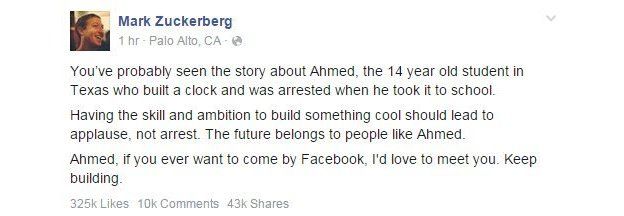
As a result of this event, Ahmed has been recognised by important figures such as President Obama and Mark Zuckerberg which can be seen in the images below. 

President Obama tweet:
Mark Zuckerberg wrote on Facebook:  


MY OPINION ON THE NEWS STORY

I think it is awful that Ahmed's clock was mistaken for a bomb because the teachers and police immediately panicked and disregarded his talent and I believe they had this reaction due to his religion (muslim) and the negative stereotypes the media has created around this belief. Although the police claimed that this was not the reason they arrested him, I feel it still partly is because if, for example, a white boy had brought in a hand made clock, the teachers would be very unlikely to phone the police so I believe this incident was down to Islamaphobia. Ahmed must have been very upset because he innocently made a clock which he was clearly very proud of and for it to be disregarded in such a harsh manner is unacceptable and I am glad he is gaining the recognition he deserves. 


Wednesday, 16 September 2015

Black Mirror


Black Mirror is a television series currently consisting of three seasons which were made between 2011 and 2015. It was created by Charlie Brooker and it stars Daniel Kaluuya (Bing), Toby Kebbell (Liam), Rory Kinnear (Michael) and Hayley Atwell (Martha). The episodes are not linked, with each one having different characters and narratives but overall, Black Mirror is about a dystopian future “that shows the dark side of life and technology”, giving the audience a variety of different situations designed to shock and disturb them and providing them with a new sense of awareness.

Black Mirror falls under the genres of a dystopian, sci-fi, thriller drama with occasional aspects of comedy. It makes the audience question ‘what if’ to a challenging future which is based upon the development of technology and the anxiety that revolves around the talk of these possible developments. The show holds up a ‘black mirror’ to society and reveals a distressing future to the audience without shying away from the extreme possibilities which trigger dark thoughts as to whether you would undergo such actions. The thriller element helps to keep the audience intrigued and at times, they will find themselves flinching away from the screen due to the horrifying possibilities and images that are being displayed before their eyes. Drama is an important part to this series because the focus is not just on technology, but also on how the characters in each episode have adapted to it and how they have grown to have an acceptance towards a life which in this time, would be seen as completely unacceptable by many people.

I have watched the first and second episode of Black Mirror and the narratives were based on very different plots within a dystopian future. The main similarities that I noticed between them were the linear narratives, the build-up of tension and the constant plot twists. In the first episode, a member of the royal family, Princess Susannah is being held hostage and she can only be freed if the prime minister has sex with a pig live on national television. The plot takes many twists and turns meaning throughout, the audience have no idea as to whether or not the prime minister will do as requested and the final twist reveals the message is not about the crime (kidnapping the princess), but about what happens because of it. This is a humiliating concept which is designed to stay with the audience and it also shows the scary power of social media as the video explaining what the prime minister needs to do goes viral extremely quickly, meaning everyone knows what is happening. There are negative representations in this episode because the princess is portrayed as ‘the damsel in distress’ who needs a man to rescue her and prevent her death, representing women to be weak, vulnerable and helpless. Additionally, the prime minister and those working around him fit into the category of our dominant ideology which represents white, straight, middle-aged, middle-class males as the superior beings of our society, who have control over the rules and regulations and we do not see many other races or genders, showing them to be ‘powerless’.

Episode two focuses on the everyday lives of those living in a dystopian Britain and we are given an insight into their routines and the limited opportunities they are presented with. The people have to pedal on exercise bikes for a living, their currency is merits and their only entertainment is loud shows and advertisements which they are forced to watch if they do not have enough merits to ‘skip’ them. Another focus is a talent show called Hot Shot, enabling people to escape from their draining reality if they win. Again, there are many plot twists to reveal a devastating ending which possibly goes to show that there are no happy endings in a future that is so dark and lifeless. I personally found the episode slow-moving and dull but this may have been to represent how the characters felt living the lives they do so the audience are given the opportunity to become a part of their repetitive, tedious world, resulting in us feeling anxious for the future and grateful for what we have now.

In conclusion, I thought Black Mirror was a very unique show and I had definitely never seen anything like it before. The different concepts were shocking and they made me think about the scary impact of technology and I like how each episode has a deeper meaning. However, as the episodes were quite slow-moving, I found them difficult to get into and I couldn’t connect to the characters as they changed each episode so I would only rate this series 5.5/10.


Misfits


Misfits is a television series made up of five seasons which were created between 2009 and 2013. The series was created by Howard Overman and there were a total of fourteen directors with the most common ones being Tom Green and Jonathan Van who directed six episodes each. Starring Nathan Stewart-Jarrett (Curtis), Joseph Gilgun (Rudy), Iwan Rheon (Simon), Lauren Socha (Kelly), Antonia Thomas (Alisha) and Robert Sheehan (Nathan), Misfits is about a group of teenagers doing community service who get struck by lightning during a mysterious storm which then enables them to develop superpowers.

I believe that Misfits falls under the genres of urban drama, sci-fi and comedy. The fact that it is an ‘urban drama’ is immediately recognisable in the first episode mainly due to the director’s choice of mise-en-scene and sound. In the opening sequence, the audience are introduced to the six teenagers who are getting ready for their community service. There is diversity within these characters regarding their race, gender and also the way they choose to wear their orange overalls. Urban areas are known for having higher crime rates so community service can be seen as a stereotype of these places and they are also known for having diversity. The opening theme song is ‘Echoes’ by The Rapture and it is in the genre of dance-punk which is another stereotype of urban areas and is likely to be popular amongst teenagers, additionally indicating that the target audience is teenagers/ young adults. The colloquial register used by the teenagers is another convention of an urban drama, with the use of lexis such as “you’re a prick man” and “dickhead”.

The sci-fi element is shown through the supernatural focus which develops from the powers that the teenagers gained in the storm. These powers include immortality, invisibility and the ability to turn back time which of course meant that special effects had to be used in the production of the show which is a convention of the sci-fi genre. The character of Nathan makes the comedy genre much more apparent in the show as he is very sarcastic and is constantly seen making jokes, often to annoy the other characters and this is amusing for the audience.

The narrative of Misfits is mostly linear as it follows a ‘beginning to end’ order and I believe the majority of the episodes could be placed into Todorov’s narrative theory because the equilibrium at the beginning of the episode is most often returned to at the end, with disruptions in the middle. In the first episode, Curtis uses his power to have a flash forward which provides himself and the audience with an alternative narrative which does not fit into the linear structure and instead, is a split narrative for that short period of time. As the episodes develop, the audience begin to understand that the power each character has received reflects their personality. For example, Simon has the power of invisibility and this reflects his characteristics because he is very shy and wants to hide away from the other characters as he does not fit in with them. Curtis used to be a runner but after getting caught with drugs, he was banned from the sport and we learn that he misses it immensely so he was given the power to turn back time because he wishes he could run again and regrets what he did.

There are three main representations in misfits which revolve around age, gender and regional identity. Youth is represented very negatively because the stereotypical characteristics of teenagers are used such as carelessness, violence, laziness, rudeness and being disruptive. The themes of crime and community service portrays teenagers as menaces in our society, particularly regarding theft, alcohol, drugs and the gang also have a habit of murdering their probation workers. There is also a focus on the problems teenagers are likely to face regarding how they are viewed by others, family issues and sexual relationships which should be relatable for the audience. The character of Alisha portrays females in a negative and sexual light as they are represented as always wanting male attention and the power Alisha is given means that if someone touches her, they will immediately want to have sex with her. She is quite often wearing low cut tops, exposing her breasts and her two main relationships throughout the series usually focus on her sex-life. An example of how regional identity is represented is through the character of Kelly who is a Northerner. At the beginning, the other characters make fun of her accent and this, along with her clothing and attitude, portray her to be a ‘chav’ which is quite a negative identity to have.


In conclusion, I loved the series Misfits because the strong character development enabled me to become emotionally attached to the characters however, I only watched up to series three because I did not like how they changed the cast for seasons four and five as I had grown to really like the original characters. Each episode has a new plot twist and a different situation the characters have to face which kept me interested throughout the seasons and from what I watched, I would rate the show 9.5/10.